Immigration, Scapegoats, and the Moral Collapse of Vigilantism
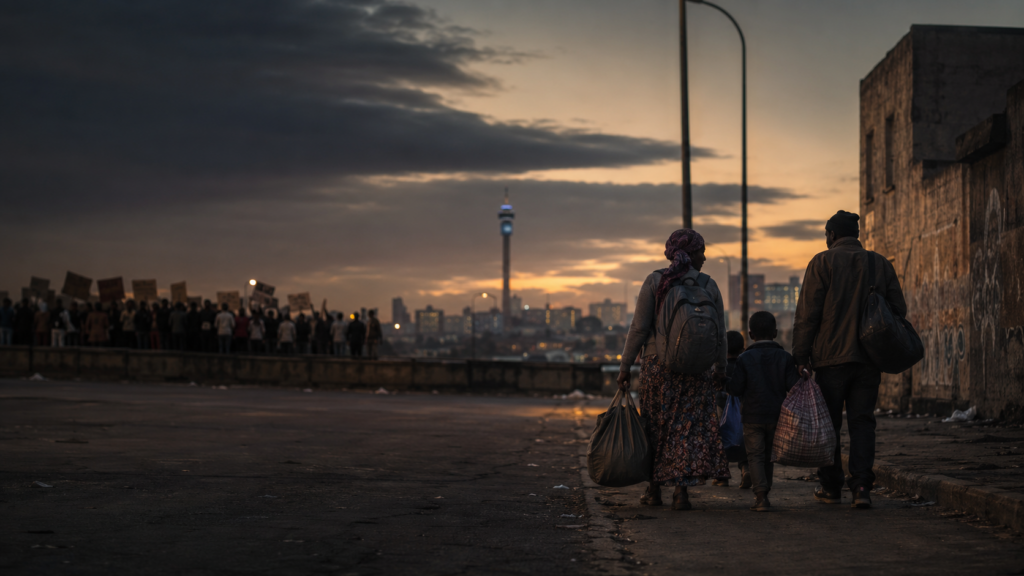
How fragile life can be.
We plan. We strategize. We cross borders with the trembling hope that somewhere beyond fear there is work, bread, safety, and room to breathe. We imagine a greener lawn in a faraway place. Then we arrive and discover that the lawn is not magic. It must be mowed. It must be earned. It may be fenced. And, if fear takes hold of the people around us, we may be forced out of that green pasture before our children have even learned its street names.
There are several things that can uproot people. For instance, a person can be uprooted by war. A family can be scattered by famine. A worker can be displaced by poverty, public disorder, political collapse, or plain old desperation. But there is a special grief in fleeing not from an invading army, an earthquake, a flood, but from neighbors. That is the grief now haunting parts of South Africa.
In recent weeks, South Africa has been in the news not primarily for the old wound of apartheid, nor for the dangers of its mines, nor for the promise of its democracy, but for a renewed and ugly xenophobia. Immigrants, both documented and undocumented, have been placed under suspicion and, in some cases, under direct threat. Some have fled or tried to leave not because a foreign army crossed a border, but because the people next door began to see them as the enemy.
That should trouble every serious person; Africans, Christians, and lawyers. Anyone who still believes that the human person must not be reduced to a political slogan should be troubled by the Xenophobia in South Africa.
A Nation Afraid
I do not pretend that South Africa’s anxieties are imaginary. That would be lazy and unfair. South Africa has carried a heavy national history. For decades, Black South Africans suffered under apartheid, a system that denied them employment, public services, land, safety, and basic human dignity in their own country. The country still bears the scars of that injustice. High unemployment, poverty, crime, housing pressure, and strained public services are not theories to people who live under their weight every day.
Fear does not come from nowhere. Even the most unreasonable phobias usually have roots. Xenophobia is not born in a vacuum. It grows in soil made bitter by scarcity, humiliation, insecurity, political neglect, and the human need to blame someone visible when the real causes are tangled and hard to defeat.
Still, explanation is not excuse.
It is one thing for citizens to demand lawful immigration policy, secure borders, orderly public services, and honest government. It is another thing for private groups to issue deadlines to human beings, march through communities with threats, break into homes, force people out, or present themselves as the hand of the state. A nation may enforce its immigration laws. Citizens may advocate for reform. Communities may demand accountability. But civilians do not become immigration officers because they are angry. They do not become judges because they are unemployed. They do not become executioners because public services are failing.
A deadline issued by private citizens is not law. It is a dare to disorder.
According to Reuters reporting, anti-migrant groups set an unofficial June 30 deadline for undocumented migrants to leave the country. The protests that followed were not all violent; many marches were peaceful. But some turned ugly, with looting, violence, arrests, and fear spreading through migrant communities. Reuters also reported more than 900 arrests connected to the unrest and the deployment of more than 3,000 soldiers to support police. The same reporting noted that immigrants make up about 4% of South Africa’s population, while supporters of the protests blamed them for unemployment, crime, and pressure on public services.
If roughly 4% of a population can be made to carry the blame for a nation’s unemployment, crime, housing pressure, and public-service failures, then the deeper problem is not simply immigration. Something is broken in the house itself.
Rule of Law or Rule of the Mob
As an attorney who has practiced immigration law in the United States, I know this much clearly: immigration enforcement belongs to lawful government. It does not belong to street movements, landlords, mobs, angry neighbors, or anyone who wakes up one morning and decides that fear gives them jurisdiction.
A lawful government may investigate, detain, remove, regularize, prosecute, or reform policy according to law. Citizens may protest, vote, organize, petition, and demand better enforcement. But when a crowd starts forcing immigrants from their homes, the issue is no longer merely immigration. It is public order, and the collapse of legal authority into private intimidation.
President Cyril Ramaphosa has warned that citizens do not have the authority to enforce immigration laws. That is right as a matter of law, and it is right as a matter of moral order. But the warning also reveals the danger. Once people believe the government cannot or will not act, some will appoint themselves government and label it patriotism. They will call it community protection or taking their country back. But a mob with a flag is still a mob.
A society that lets civilians enforce immigration through threats and violence is not becoming stronger. That society is becoming lawless. It is trading one form of disorder for another and pretending that the second disorder is nobler because it speaks the language of national pain.
The rule of law is not sentimental. It does not mean a country has no borders or that everyone may enter, stay, or work without consequence. It means the state acts through law, not vengeance. There should be process, not panic. Authority, not chaos. It means that even when a person has violated immigration law, the response must still be governed by lawful procedure and basic human dignity. How can a mob determine who is legal or illegal immigrant?
The Stranger at the Gate
The fact of the matter is that the immigrant is not a policy problem with a face. He is a human being. She is a mother. He is a father. She is a worker. He is a son who may have crossed a border in desperation. She is a daughter who may have left home because home became unlivable.
Some migrants are lawfully present. Some are not. Some may have strong humanitarian claims. Some may have no legal right to remain. The legal distinctions matter and should not be brushed aside. But none of those distinctions erase the person’s humanity.
Catholic social teaching does not require nations to abandon borders. To the contrary, Catholic social teaching recognizes and supports prudence, order, and public safety. A government has a duty to its citizens. A nation that cannot regulate entry, work authorization, public benefits, and security will eventually create resentment among its own people and vulnerability among migrants. Chaos is not charity any more than recklessness is mercy.
But Catholic social teaching also refuses to treat the stranger as disposable. The undocumented migrant is still a soul. The citizen without work is still a soul. The poor South African mother trying to feed her children and the frightened foreign father trying to avoid violence are not enemies by nature. They are often two wounded people standing in the same long line of human need.
The moral failure begins when politicians, protest movements, and opportunists teach the poor to fear the poor. The unemployed citizen is told that the migrant stole his future. The migrant is told that the citizen hates his existence. Meanwhile, the deeper failures remain standing: weak institutions, corruption, economic stagnation, porous systems, poor planning, collapsed trust, and leadership that too often arrives after the fire has already spread.
When the Poor Are Taught to Blame the Poor
South Africa’s unrest is not really only about immigration. Immigration is the visible match. The dry grass is much larger: unemployment, scarcity, weak public systems, housing pressure, crime, political frustration, and the long afterlife of apartheid’s economic wounds.
When the state fails to manage those realities honestly, people search for a face to blame. Migrants become convenient because they are visible, vulnerable, and often politically powerless. They sell in the market. They rent in the township. They stand in the clinic line. They work for less because survival does not negotiate like comfort does. And suddenly a suffering citizen is told that the stranger, not the broken system, is the chief thief of his peace.
That is an old political trick. It has been used across continents and across centuries. When the economy tightens, blame the foreigner. When public services fail, blame the outsider. When the young cannot find work, blame the person with an accent. When crime rises, blame the stranger’s presence rather than the state’s inability to enforce law with consistency and fairness.
But how does scapegoating feed hungry a child? Can It build a schoo? Repair a clinic? It never creates a job. It never restores trust between citizen and state. The only thing it does effectively is to provide anger and a temporary target, while the real wound left untreated.
The tragedy is that the poor often pay twice. The citizen pays through unemployment, insecurity, and broken public systems. The migrant pays through fear, exploitation, displacement, and sometimes violence. Then both are asked to fight each other while the deeper failures hide in plain sight.
Africa’s Wound: Displacement Without Dignity
This is not only a South African story. It is an African story. It is a human story.
People do not leave home for sport. They do not abandon familiar languages, graves, churches, farms, markets, relatives, and childhood streets because crossing borders is entertaining. Many leave because conflict has eaten their security, poverty has left them with no options. Corruption ate their future, hunger erased their patience, or fear has left them sleepless.
The question is, does that mean every country must absorb every person who arrives? No. A serious nation cannot govern that way. A nation must know who is within its borders. It must protect its citizens and enforce its law. It is the government’s duty to ensure that migration is managed, documented, and consistent with the common good.
But cruelty cannot be the answer to disorder. The answer to illegal immigration cannot be mob enforcement. The answer to public frustration is not private terror. A country does not heal itself by humiliating the vulnerable. It only teaches its children that power, not law, is the final argument.
There is also an economic foolishness in xenophobic violence. When families are uprooted, businesses are disrupted. When workers flee, supply chains are disturbed. When shops are looted, communities lose goods and livelihoods. As fear spreads, children miss school, parents stop working, neighborhoods fracture, and public resources are diverted from development to emergency control. A society that says poverty is the reason for the unrest had better not ignore the poverty that unrest creates.
What Order Requires
South Africa has the right to secure its borders and enforce its immigration laws. That should be said without hesitation. But no nation has the right to cure disorder with cruelty. When frightened citizens become immigration officers, judges, and enforcers in the street, the nation has not solved its crisis. It has revealed a deeper one.
Public order requires borders, law, truth, and it requires mercy. All these four elements are needed.
South Africa’s leaders must enforce immigration laws through proper channels, protect citizens, prevent criminality, and refuse the temptation to let mobs do what the state is afraid or unable to do. Civil society must stop pretending that intimidation is civic engagement. Religious leaders must remind their people that the stranger is not exempt from God’s image. And the international community must look honestly at the conditions that keep forcing Africans to leave home in search of survival.
The stranger at the gate may be undocumented. He may be desperate. He may need to be processed under the law. But certainly, he must not be hunted nor reduced to a slogan. That stranger at the gate must not be turned into the sacrifice offered on the altar of national frustration.
Sources consulted for factual background
These source notes are included for review and publishing support. They may be converted into hyperlinks, footnotes, or removed depending on the final publication format.
• Reuters, July 9, 2026: South African protesters go door-to-door forcing immigrants from their homes
• Reuters, July 3, 2026: South Africa deploys troops to bolster security during anti-migrant protests
• Reuters, July 1, 2026: Over 900 arrested during South African anti-migrant protests
• Reuters, June 30, 2026: South Africa’s anti-migrant protesters march nationwide
• Reuters, June 29, 2026: South Africa’s anti-migrant deadline forces fathers to leave families behind