How the Iran-Hormuz Crisis Breaks the Chain from Kano to the World
By Ada Egbufor
Not many people know a lot about the journey food takes before it ends up on their dining table.
People buy what they need, cook, eat, and move on. A bag of beans becomes soup, a loaf of bread becomes breakfast, and a carton of milk becomes routine. The journey behind it is mostly invisible.
Modern life has made food look simple. But this simplicity frequently masks a complex network of connections.
Migration, urbanization, wealth, and convenience have pulled many people farther from the soil. Packaged food is normal, processed food is familiar. Children know brands before farms. Many consumers know only the shelf price, not the hands, roads, fuel, credit, weather, and bargaining that go into the food.
As people move away from their homelands, they also learn to adopt new lifestyles, including new food habits. This drives increased demand for moving food products over greater distances.
But before food moves, someone must grow it.
In places like Maigari, Kano, there may be someone like Hadiza.
Hadiza’s cowpeas do not jump from her half-acre plot to a supermarket shelf in Lagos, Atlanta, or London by miracle. There is a chain. There is a bridge. That bridge is often called the aggregator — sometimes called the middleman, cooperative buyer, or agribusiness. The aggregator gathers crops from multiple small farmers, organizes logistics for transport, manages storage, and ensures the crops reach larger markets or processors, connecting the farms to the food supply chain.
The aggregator is a key connector, enabling the Hadizas of the world to participate in the wider food economy by linking their crops to markets they could not access on their own.
Without that bridge, Hadiza may grow the cowpeas, but she may not be able to sell them outside her immediate surroundings. She may have food in her field and still be locked out of the market.
The Role of Aggregators: The Missing Link
In Maigari, the global market is not a stock exchange.
It is a battered, diesel-smelling truck that comes into the village on schedule — or fails to come at all.
It is a buyer with a scale, a notebook, a price, and the power to decide whether the harvest of many small farmers will move beyond the village. That buyer may purchase directly from farmers, or through self-help community farmer groups, women’s farming circles, cooperatives, or other local networks.
This is how small harvests become marketable volume.
One woman may not produce enough cowpeas to supply a processor, exporter, or large distributor. But when an aggregator buys from hundreds or thousands of women farmers, the little sacks become a truckload. The truckload becomes a commercial quantity. Commercial quantity becomes food for cities, processors, institutions, and export markets.
That is the protein bridge.
Aggregators help farmers bypass barriers they cannot manage alone: waste, transport, packaging, processing, storage, and getting access to larger buyers. In the best situations, aggregators not only buy crops but also organize logistics, provide information on market standards, and build essential links between rural farmers and the larger economy outside their village.
But aggregators are not in this business as charity.
They are in it for profit.
That does not make them evil. It makes them business people. Their trucks need fuel. They must pay their workers. Their buyers demand volume. They must repay their lenders, and guess what, their own households must eat. So when the cost of doing business rises, the aggregator does what most businesses do: he protects his margin.
And that is where the woman farmer begins to feel the squeeze.
The Iran-Hormuz crisis raises costs across the supply chain: fertilizer, diesel, transport, insurance, and credit. Routes that were barely profitable may become unviable for aggregators.
Before the war, a liter of diesel reportedly cost around ₦1,000 to ₦1,200. At the time of writing, it has risen to about ₦1,800-₦2,000 — an increase of roughly 70%. [GlobalPetrolPrices.com; The Africa Report]
In economic terms, this is known as the Hormuz effect.
If the aggregator pays more for fuel, he will not simply absorb the cost and smile. He will offer Hadiza less for her cowpeas. Or he may stop coming to her village altogether.
He may stay on paved highways, buying only from “Tier 1” farmers closer to major roads. They are easier to reach, have larger quantities, and reduce transport risk. For women like Hadiza, living miles away down muddy tracks, the cost becomes too high.
That is how exclusion happens.
Not always through hatred.
Sometimes through diesel.
Sometimes through distance.
Sometimes, through a business decision made by someone who is also under pressure, but who still has more options than the woman at the bottom of the chain.
The Squeeze of 2026
The squeeze does not happen in only one place.
It starts with fertilizer. It continues with transport. It shows up again in the credit. Then it appears at harvest when the buyer decides what price to offer, what quality to accept, and which farmer is worth the trip.
In Sub-Saharan Africa, including Nigeria and Uganda, many farmers rely heavily on imported raw fertilizer materials or finished fertilizer blends. When maritime choke points in the Middle East are disrupted, the cost of nitrogen fertilizer can rise sharply because oil, gas, shipping, insurance, and manufacturing costs are tied together. According to the World Bank Commodity Markets Outlook, major disruptions to Middle Eastern maritime routes have historically led to global spikes in fertilizer prices, particularly nitrogen-based fertilizers. [World Bank Commodity Markets Outlook]
When input prices rise that fast, the pain does not stay in the ports or in a policymaker’s office. It travels down.
To reache the importer.
To reache the distributor.
To reache the aggregator.
It reaches the woman who only wanted enough fertilizer to grow beans.
In a good season, an aggregator or agribusiness partner may be willing to extend fertilizer on credit to women farmers. The farmer receives fertilizer now, plants, harvests, and repays later when the aggregator buys the crop. This type of arrangement can help low-income farmers who do not have cash available during the planting season.
But this system is fragile.
If fertilizer and diesel costs double, lending risks and transportation costs rise. If the aggregator’s financing grows more expensive, he evaluates which farmers are worth the risk.
And women like Hadiza are often the first to be cut off.
The breakdown does not happen in a vacuum.
In programs like the IFC-backed Grainpulse venture in Uganda, aggregators have helped build systems that provided female bean growers with specialized fertilizer on credit, along with a guaranteed buyer at harvest. That kind of model was designed to close part of the gender productivity gap by giving women farmers access to inputs and markets they might not otherwise reach. [IFC/Grainpulse]
But even good systems can crack under outside pressure.
As the International Food Policy Research Institute has shown, credit networks and input-support systems are highly sensitive to external shocks. When geopolitical crises drive up oil and natural gas prices, fertilizer manufacturing and shipping costs rise. When fertilizer costs rise too quickly, the aggregator who extends credit to vulnerable women farmers begins to see danger instead of opportunity. [IFPRI]
The math becomes brutal.
If Hadiza cannot repay, the aggregator loses.
If the aggregator is unable to recover the loan, the lender loses. And if the lender tightens credit, the next group of women may not be able to secure any loans. The result is that the aggregator suspends the credit program. Or he reduces the number of women who qualify. He may also decide to give priority to farmers with more land, better road access, better collateral, or stronger ties to the market. Guess what, the Hadizas are told to face the open market alone.
But the open market is not an equal place. It favors the person with cash, storage, transport, bargaining power, and time.
Hadiza has none of these.
She is now forced to sell quickly because school fees cannot wait. She needs the cash because medicine cannot wait, and hunger does not wait for the market to improve.
This is how the global Iran-Hormuz crisis becomes personal for smallholder women farmers and families worldwide.
It enters the soil as expensive fertilizer.
You see it as costly diesel, lower farmgate prices, and smaller meals.
Quality Matters
This is business. The aggregator does not just buy beans. He buys beans that meet a certain quality for the supply chain.
The global market, processor, exporter, and end buyer may want cowpeas that are clean, dry, uniform, properly stored, and suitable for processing or export. These standards do not disappear because Hadiza is poor.
But quality is not magic.
Quality requires inputs. It requires timing. It requires fertilizer, water, storage, drying space, bags, transport, and sometimes technology. If a woman farmer cannot afford the right fertilizer, lacks irrigation, cannot store properly, or the crop sits too long because the buyer did not come on time, her beans may not meet the required standard.
Then the aggregator rejects her crop.
Or he downgrades it.
Or he offers her a price so low that it feels like punishment.
This may appear cruel, but the aggregator will say he is only doing business. He is also passing the geopolitical tax down to the woman at the bottom.
That is what people do not see.
A war or blockade far away does not have to bomb Hadiza’s farm to hurt her. It only has to raise the cost of fertilizer and diesel, weaken the credit system, and tighten quality demands that she no longer has the inputs to meet.
When her crop is rejected, the market calls it poor quality.
Still beneath that phrase is another truth: input poverty has become market exclusion.
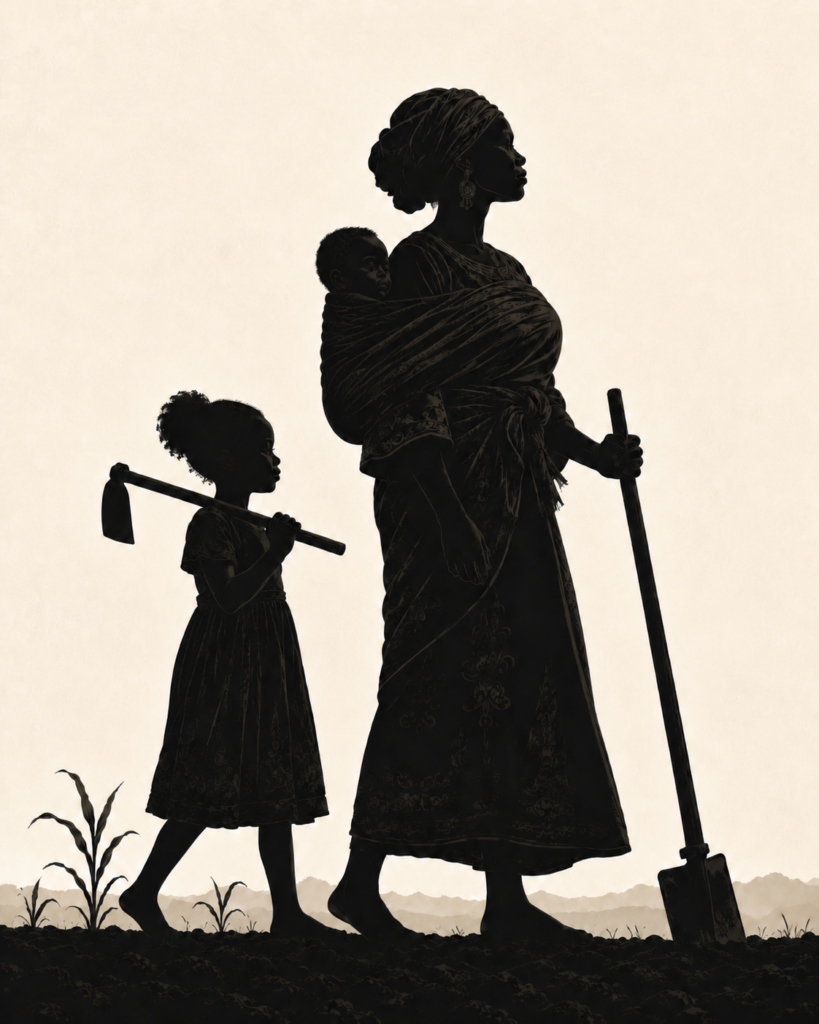
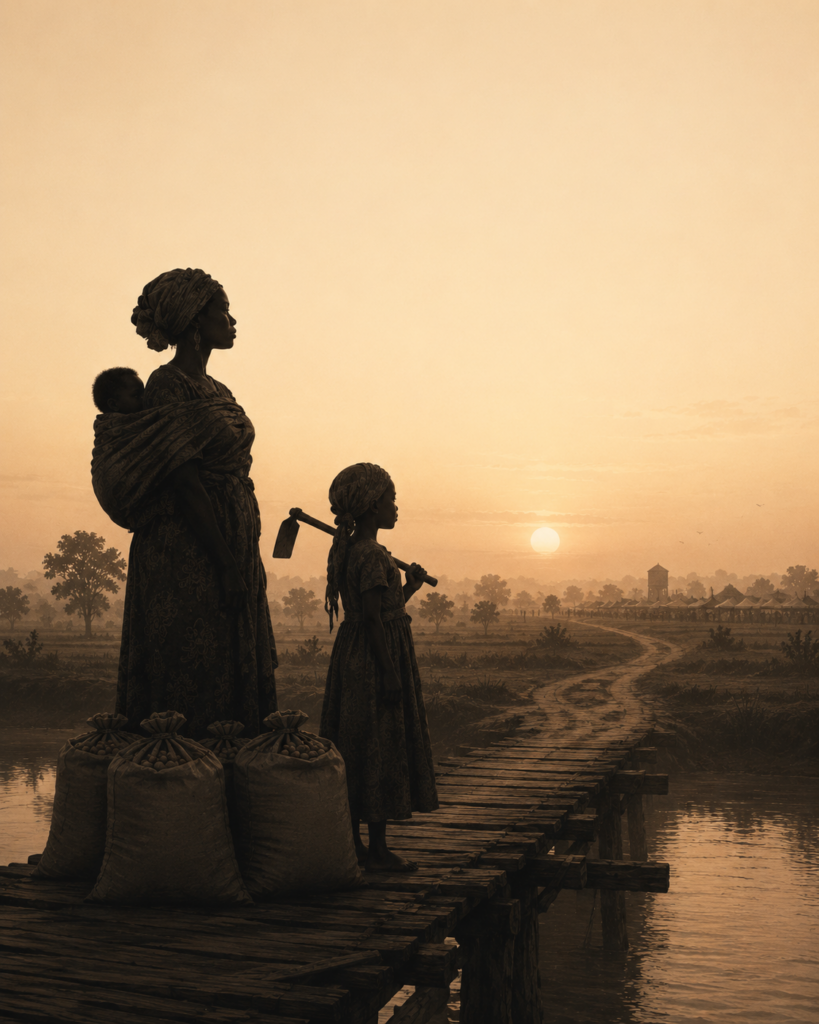
Hadiza may have done everything her strength allowed. She may have planted early. She may have weeded. She may have prayed over the rain. She may have carried Jibril on her back while Amina walked beside her with the little hoe on little her shoulder. She may have harvested what the soil gave her.
Still, her crop may not qualify for the better buyer because the tools needed to meet that standard were priced beyond her reach.
The world may call this a supply-chain adjustment. Hadiza calls it a loss.
Who Carries the Loss?
In every food chain, someone carries the loss.
The question is: who?
The large buyer may reduce an order. The processor can change suppliers.
The aggregator may choose to avoid distant villages. While the transporter increases his charge. On the other hand, the lender may tighten credit, the farmer may sell at a loss, and the poor mother may be forced to reduce the pot of soup.
So, by the time the food reaches the consumer, the price appears to be just another market increase. People complain, adjust, substitute, or buy less. But long before the consumer sees the higher price, the woman farmer has already absorbed several blows. How?
She has paid more for fertilizer and for transport. But, she received less from the aggregator or lost access to credit.
She watched the buyer favor farmers closer to the paved road.
Right before her eyes, she watched quality standards grow harder to meet as the bridge narrowed.
This is why women farmers can be essential and still be invisible.
They are close to the soil, the household, the market, hunger, and survival. They are often the ones who know how to stretch food when prices rise. They are the ones who know what it means when beans become too expensive for the poor. They are the ones who feel the price of fertilizer not as an economic chart, but as a decision between planting less or borrowing more. These women are rarely the ones with power. Not even close to it.
Women like Hadiza, all over the world, especially in developing countries, feed the system, but they do not control it.
They produce the crop, but they do not set the price.
They carry the risk, but they do not write the rules.
That is the contradiction at the heart of the protein bridge.
The bridge depends on women like Hadiza, but it is not built for them.
The Road the Truck No Longer Takes
There is a road to Hadiza’s village.
It is a moody, dusty road, not the one that looks good in a development brochure. It is not a clean highway with smooth shoulders and easy access. This is the kind of road that becomes treacherous after rain, then makes a driver calculate whether the trip is worth the diesel. In a normal season, maybe the aggregator comes. In a hard season, maybe he does not.
He may decide to stop at the larger farms near the highway. He may tell himself he will return later. He may promise the women that next week will be better. But next week, diesel may rise again. The truck may need repair. The buyer may reduce the price. The road may get worse. And Hadiza waits; Her cowpeas wait with her.
This is one of the quietest forms of exclusion. It is never announced. Nobody issues a formal policy. Nobody says, “We have decided that women farmers far from the paved road no longer matter.” The truck simply stops coming. And when the truck stops coming, the bridge breaks.
This broken bridge does not appear catastrophic, as if it were hit by a tornado or lightning. Sometimes it may look like a woman sitting beside sacks of beans, knowing that every passing day lowers her bargaining power. Sometimes it looks like a child not going to school because the harvest did not bring what it should have, or like a mother watering soup with silence.
Conclusion: The Protein Bridge
The chain from Kano to the wider market rarely breaks in a single quick moment. It weakens in ordinary places.
The fertilizer seller raises his price. The diesel cost makes the aggregator think twice before sending his truck into a village road. The buyer offers less because his costs have gone up. A credit arrangement that helped women farmers last season suddenly becomes too risky. A processor rejects beans that would have been better if the farmer had been able to afford the right inputs.
By the time people in the cities begin to talk about food prices, Hadiza has already felt the crisis in several ways. She has paid more to plant, waited longer to sell, received less than she expected, and still has school fees, medicine, and food to worry about.
So, you see why Hormuz is not just about ships, oil, and international politics. For women like Hadiza, it is a truck that does not show up, a buyer who offers too little, a bag of fertilizer she cannot afford, and a blurry harvest without the promise it should.
This is the protein bridge. It connects a woman’s field to the family table. And when it weakens, the woman closest to the soil is often the first to carry the loss. It is the story of how a crisis far from Kano can break the protein bridge between a woman’s field and a family’s table.
If that bridge continues to weaken, the cost will no longer be measured only in export numbers, commodity charts, or shipping reports. It is soon to be measured in children pulled from school, medicines purchased suspended, meals spread thin, and women farmers pushed further away from the profits of the very food they produce.
The world must stop pretending that food systems are neutral. Food systems are built via choices such as the choice about:
- Who receives credit?
- Who gets fertilizer first?
- whose road is worth traveling.
- whose harvest is worth collecting.
- whose hunger is treated as urgent.
Hadiza stands at the end of those choices.
And still, she plants.
The point is simple. When the costs of fertilizer, fuel, and credit go up, someone pays for them. All too often, that person is not the importer, the big buyer, or the person sitting in an office looking at commodity prices. It is the small farmer. It is the woman who has already done the hard work of planting, weeding, harvesting, and waiting.
For Hadiza, the Iran-Hormuz crisis is not a foreign policy matter. It is whether the truck comes. It is whether the aggregator pays fairly, whether she can buy fertilizer next season. It is whether her cowpeas will feed her family or rot because the market moved away from her.
That is the protein bridge. It is fragile, and women like Hadiza are standing on the weakest part of it.
In the final part of this series, I will look at the legal, political, and policy choices that keep women farmers at the bottom of the food chain, even though the world depends on their labor.
_______________________________________________________
Author’s Note
Maigari and Kano are real; legumes are grown there; and the fertilizer-price pressures described in this essay are grounded in research. But Hadiza is a representative persona created to reflect the lived realities of many women smallholder farmers. Her name stands for many women whose burdens rarely make the headlines.
Sources
GlobalPetrolPrices.com.
The Africa Report.
World Bank Commodity Markets Outlook.
International Finance Corporation / Grainpulse materials on women bean growers and fertilizer access.
International Food Policy Research Institute materials on input markets, gender productivity gaps, and food-system shocks.
Reuters reporting on the Iran-Hormuz crisis, fertilizer, fuel, and food system pressures.
Daily Trust reports on fertilizer prices and the effect of the Iran crisis.