What the Hormuz Crisis Reveals About Women, Agriculture, and Economic Power
By Ada Egbufor
In Parts One and Two of this series, we saw that Hadiza had no hand in the Hormuz crisis, yet she suffers its repercussions the most.
That is the cruelty of the present food system. The woman who did not start the war, insure the ship, set the diesel price, control the fertilizer market, or design the supply chain is often the one left standing at the end of the road, wondering how to feed her children.
So the question for this final part is simple: when did Hadiza’s vulnerability begin? And would the end of the U.S.-Israel aggression against Iran erase it?
The answer is no.
Hadiza’s vulnerability did not begin at Hormuz. The crisis only exposed what had already been there. For many years, research from FAO, IFPRI, the World Bank Group, IFC, and others has identified women’s limited access to finance, inputs, technology, information, land, storage, and markets as structural barriers, not isolated personal failures.
The Hormuz crisis did not create the fault line.
It revealed it.
What happens if the truck returns to Maigari? What happens if diesel and fertilizer prices return to pre-crisis levels? What happens if shipments resume and the Strait of Hormuz disappears from the headlines?
Hadiza may breathe a little easier for a season. But her vulnerability will remain unless something more fundamental changes.
Parts One and Two established the tragedy: how a conflict in the Middle East can choke fertilizer supplies, raise diesel prices, and keep the aggregator’s truck from reaching women farmers like Hadiza. Part Three must now focus on resilience.
Not the fashionable kind of resilience where the poor are praised for surviving what should never have been placed on their backs.
Real resilience.
The kind that asks: how do we build a food system where a mother in Kano is not held hostage by a war in Hormuz?
The fact of the matter is that true food security will not come from merely repairing the old, fragile global supply lines. Those supply lanes were already unequal. They were already too long, too centralized, and too controlled by people far removed from the soil.
The system must be intentionally decentralized.
Women farmers need more than praise. They need legal, financial, technological, and market power. They need the kind of sovereignty that allows them to plant, borrow, produce, store, sell, and negotiate without being crushed every time the world sneezes.
Food security asks whether food is available.
Food sovereignty asks a deeper question: who controls the food, the land, the seeds, the inputs, the market, and the profit?
That is the question Hadiza forces us to answer.
As I see it, there are three essential pillars for a post-war food and climate resilience strategy that recognize the role of women farmers, strengthen the global food system, and reduce the likelihood that the next crisis will once again land hardest on the woman at the bottom.
Pillar One: Structural Reform — Land Titles as Shield
Agriculture is a business, regardless of scale.
A half-acre farm is still a business. A cowpea plot is still business. A woman selling beans from her harvest is still participating in commerce. We may romanticize it as rural life, but the truth is plain: food production requires capital.
Capital comes in different forms. Sometimes it is land. It could be cash, equipment, or credit. Sometimes it is a guaranteed buyer, and other times it is information at the right time.
If a farmer needs cash capital, she may seek a loan from a bank, a cooperative, a microfinance institution, or a private lender. But lenders are not charity organizations. They are also in business. They have terms and conditions. They want collateral. They want repayment. They want to know that if they give money for quality seeds, fertilizer, irrigation, storage, or other necessary inputs, the borrower has something to stand on.
That is where Hadiza meets the wall.
If Hadiza does not legally own her land, she cannot easily walk into a bank and obtain a loan to survive the 2026 inflation wave. And truth be told, she could not easily obtain that loan even before the inflation wave. The crisis did not create the exclusion. It made the exclusion more expensive.
If women cannot legally own or securely control their land, then they cannot secure credit independently of erratic aggregator programs, informal lenders, or volatile global markets.
They farm, but the law does not fully see them.
They produce, but finance does not trust them.
They feed families, but the system treats them as temporary guests on the land.
That is not merely an agricultural issue. It is a legal issue. It is an economic issue. It is a national security issue.
In its 2010–11 State of Food and Agriculture report, the Food and Agriculture Organization found that if women had the same access to productive resources as men, they could increase yields on their farms by 20-30%. The report further found that this could raise total agricultural output in developing countries and reduce the number of hungry people worldwide by 100 to 150 million. [FAO]
That is not a small footnote.
That is a blueprint.
Land tenure reform must be treated as food policy. It must be treated as a hunger policy. It must be treated as a national security policy.
When women can own, inherit, control, and document their rights to land, they are better positioned to access credit, invest in soil health, enter into formal contracts, negotiate with buyers, participate in cooperatives, and plan beyond a single planting season.
The law can be a fence that keeps women out.
Or it can be a shield that helps them stand.
For Hadiza, land title is not just paper. It is collateral. It is dignity. It is bargaining power. It is the difference between begging for access and standing as an economic actor.
If the world is serious about women farmers, it must stop praising their labor while denying them the legal foundation on which productive labor stands.
Pillar Two: Technological Sovereignty — Local Inputs, Local Power
The second pillar is technological sovereignty.
The problem with the current system is not only that fertilizer became expensive during the Hormuz crisis. The problem is that too much of Hadiza’s productivity depends on inputs that begin far away from her soil.
Synthetic, natural-gas-reliant NPK fertilizer is often tied to the Gulf region and to long maritime routes. As long as that remains the situation, the Hadizas of this world will continue to bear the brunt of crises they cannot control.
If a ship cannot move, she suffers.
If natural gas rises, she suffers.
If insurance spikes, she suffers.
If a port is blocked, she suffers.
This is not sovereignty. This is a dependency with a farming hoe in the woman’s hand.
It is long overdue to invest in local and regional input systems. That means small-scale fertilizer blending plants in West Africa, where appropriate. It means using regional resources, including phosphate from within Africa, where feasible. It also means not acting as if imported synthetic fertilizer is the only path to productivity.
There are organic and regenerative alternatives that deserve serious investment: compost, manure, cover crops, biofertilizers, inoculants, and soil-friendly blends suited to small farms. These are not romantic backyard ideas. They are part of a serious resilience strategy when properly supported by science, training, local production, and market systems.
Legumes are naturally nitrogen-fixing. Cowpeas already know something about resilience. But depleted soils often still need help. Instead of leaving women farmers dependent solely on imported synthetic starters, training programs could equip them with advanced biofertilizers, composting, soil testing, seed selection, and regenerative practices that work for their specific acreage and local conditions.
This is where technology must come down from the conference room and enter the village.
Technology is not only drones and polished apps. Sometimes technology is a local blending plant, a solar dryer, a village soil test, and sometimes it is a better storage bag. A mobile voucher that can reach the woman’s phone directly is a necessary technology.
Digital mobile vouchers sent directly to women farmers could subsidize local, eco-friendly inputs while bypassing male-dominated structures that sometimes control access to benefits. But even digital programs must be designed carefully. If the woman does not control the phone, cannot read the message, the redemption center is too far away, or the voucher is captured by someone else, then the program exists only on paper.
The African Union has rightly noted that the challenges facing rural women farmers are deeply rooted in structural inequalities, but they are not insurmountable. With targeted interventions in financial inclusion, cooperative societies, market access, training, and trade policies, women can break free from cycles of exploitation and poverty. [AU]
That is important because Hadiza does not need pity.
She needs access.
She needs tools.
She needs a system that trusts her with technology, not one that assumes innovation belongs only to larger farms, male farmers, or urban agribusiness elites.
This is also where scalable models matter.
The IFC-backed Grainpulse model in Uganda is one example of how agribusiness can connect farmers to fertilizer, crop-specific input blends, training, and markets. AgTech financing models across Sub-Saharan Africa also show promise by combining farmer data, mobile money, credit scoring, input delivery, and buyer networks.
But no model should be treated as a miracle.
The test is not whether an app exists. The test is whether Hadiza can use it.
Can she register? Can she qualify? Can she receive credit without a land title? Can she sell through the platform? Can she control the money? Can she survive the next shock better than the last one?
If the answer is no, then the technology is only decorative.
Food sovereignty requires local power, not merely digital beauty.
Pillar Three: Rewriting the Aggregator Model — Cooperative and Digital Power
The third pillar is the aggregator model.
In Part Two, I called it the protein bridge. The aggregator connects Hadiza’s cowpeas to the wider food chain. Without that bridge, many women farmers remain trapped in the village market.
But the present model places too much power in the hands of one actor who relies heavily on diesel, road access, and his own margin. When his costs rise, he passes the buck to the woman farmer. He pays less to the woman, or skips her village. He favors larger farmers near paved roads. He withdraws credit and tightens quality demands.
This system has been a crusher on the woman farmer.
It is not enough to say aggregators are necessary. The question is: necessary on whose terms?
A better model would not remove every aggregator. That is not realistic. Aggregators perform a real function. They move crops, assemble volume, connect rural production to larger buyers, and reduce some market barriers.
But public policy and private investment should not strengthen aggregators while leaving women farmers powerless. If government, development finance, or private capital supports aggregators with credit guarantees, fuel support, working capital, or infrastructure, then that support should come with conditions.
If public or development money reduces the aggregator’s risk, then women farmers must not remain the shock absorbers.
Support should be tied to transparent weighing, fair pricing, purchases from remote communities, inclusion of women-led farms, timely payment, and grievance mechanisms that farmers can actually use.
At the same time, women need alternatives.
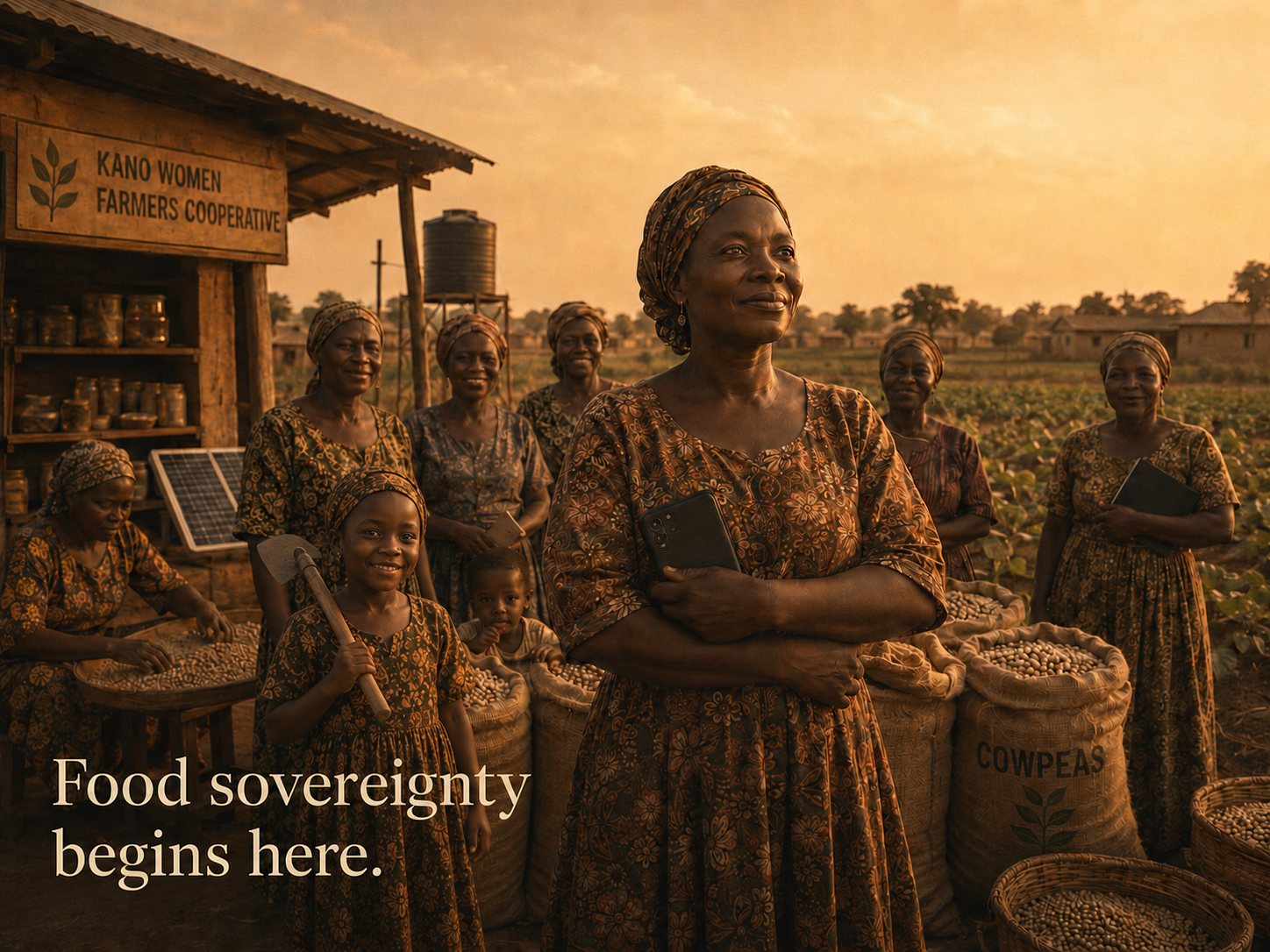
Female-led cooperatives can pool produce, purchase inputs in bulk, negotiate better prices, invest in shared equipment, and reduce dependence on a single buyer. In places like Kano, women’s cooperatives could own or lease solar-powered dryers, millers, storage units, weighing scales, moisture meters, or small processing equipment.
That matters.
Because the woman who can store her beans does not have to sell in panic.
If she can dry properly, she is less likely to be rejected for quality.
The woman whose cooperative has a scale is less likely to be cheated.
The woman who sells with others has a louder voice than the woman standing alone.
Digital business-to-business platforms can also help, if designed with women in mind. Platforms such as Farmerline, ThriveAgric, and other AgTech models point toward the possibility of linking farmers and cooperatives to inputs, financing, advisory services, and buyers. These tools may not replace the aggregator entirely, but they can provide alternatives, price visibility, and shorter supply chains.
A shorter supply chain can also become more diesel-resistant.
Warehouse receipt systems and market information systems should also be part of the conversation. If women can safely store their produce, receive a receipt, access short-term credit against stored crops, and sell when prices improve, then they are less likely to be forced into distress sales immediately after harvest.
Again, the question is not whether these models sound impressive in a report.
The question is whether they reach Hadiza.
Do they work for women with small plots? Do they work in villages far from paved roads? Do they reduce dependence on predatory middlemen? Do they increase women’s control over income? Do they make the next crisis less devastating?
If not, then the model may be scalable on paper but hollow in practice.
Evidence and Accountability: Stop Counting Women as Decoration
There is one more issue policymakers must deal with.
Stop and desist from counting women simply as beneficiaries. Women are stakeholders.
Too many programs announce that they reached “smallholder farmers” or “rural households” without telling us whether women actually received the inputs, controlled the credit, benefited from the training, sold the harvest, or kept the income.
That must stop.
If this Hormuz crisis teaches anything, it is that we need better evidence on who carries the shock.
It is not enough to count the fertilizer bags distributed. Count how many women received them.
It is not enough to count loans issued. Count how many women qualified without male guarantors.
It is not enough to count the farmers trained. Count whether the training was held at a time and place where women could attend.
It is not enough to count total output. Count whether women’s income increased.
It is not enough to say the aggregator bought from the village. Ask whether he bought from women.
A serious food resilience policy should track farmgate prices, women’s net income, credit access, repayment terms, input access, storage access, transport costs, quality rejection rates, household food security, and whether women controlled the proceeds from their labor.
Evidence matters because what is not measured is easily ignored.
And women farmers have been ignored long enough.
The Role of Government, Private Sector, and Civil Society
The government cannot do everything, but it must do what only the government can do.
It must protect land and inheritance rights. It must build feeder roads, storage systems, irrigation, rural connectivity, and market infrastructure. It must create crisis-triggered guarantees and targeted input support. The government must regulate weights and measures and curb market abuse. It must collect data separated by sex, location, crop, and farm size.
Private sector actors must stop treating women farmers as risky afterthoughts while depending on their labor. Banks, insurers, processors, logistics companies, telecom providers, input suppliers, and aggregators should design products around farming realities, not urban assumptions. Credit should match planting and harvest cycles. Insurance should be bundled in ways farmers understand. Alternative collateral should be accepted. Digital systems should account for literacy, phone ownership, and women’s time.
Civil society, including churches and faith communities, also has a role.
And I say this carefully.
It is not enough to organize occasional food drives while ignoring the women whose labor produces the food. Charity may feed a person today, and thank God for that. But justice asks why the woman who grows food remains hungry, underfinanced, underprotected, and unheard.
Civil society can help women organize cooperatives. It can provide legal literacy around land and inheritance. It can monitor whether public programs reach women. It can help document abuses. It can connect farmers with legitimate buyers and lenders. It can bring women’s testimony before policymakers.
The point is not to replace government.
The point is to refuse silence.
Conclusion: A New Blueprint for the Global Frontline
The Hormuz crisis has exposed an unsettling reality.
The global declaration of 2026 as the International Year of the Woman Farmer will mean very little to Hadiza if nothing changes on the ground.
Praise is not policy.
Recognition is not reform.
A slogan does not buy fertilizer.
A declaration does not pave the road to Maigari.
A conference speech does not give Hadiza title to land, access to credit, a fair buyer, a working storage system, or a voice in the market.
Hadiza cannot control the Strait of Hormuz. She cannot set the price of natural gas. She cannot insure a cargo ship. She cannot compel a bank to lend to her. She cannot force the aggregator’s truck to return. Yet the present food system expects her to absorb the consequences of decisions made far beyond her reach.
Resilience? No.
That is abandonment dressed in economic language.
A stronger food system would not guarantee that crises will disappear. It would make sure they do not face every crisis alone. It would protect their access to land, inputs, credit, transport, storage, technology, information, and buyers. It would recognize the aggregator as part of the bridge while ensuring that public support reaches the woman at the other end.
The Strait of Hormuz may eventually reopen. Markets may settle. Ships may move again. But unless the inequalities exposed by this crisis are repaired, the next shock will follow the same road and arrive at the same door.
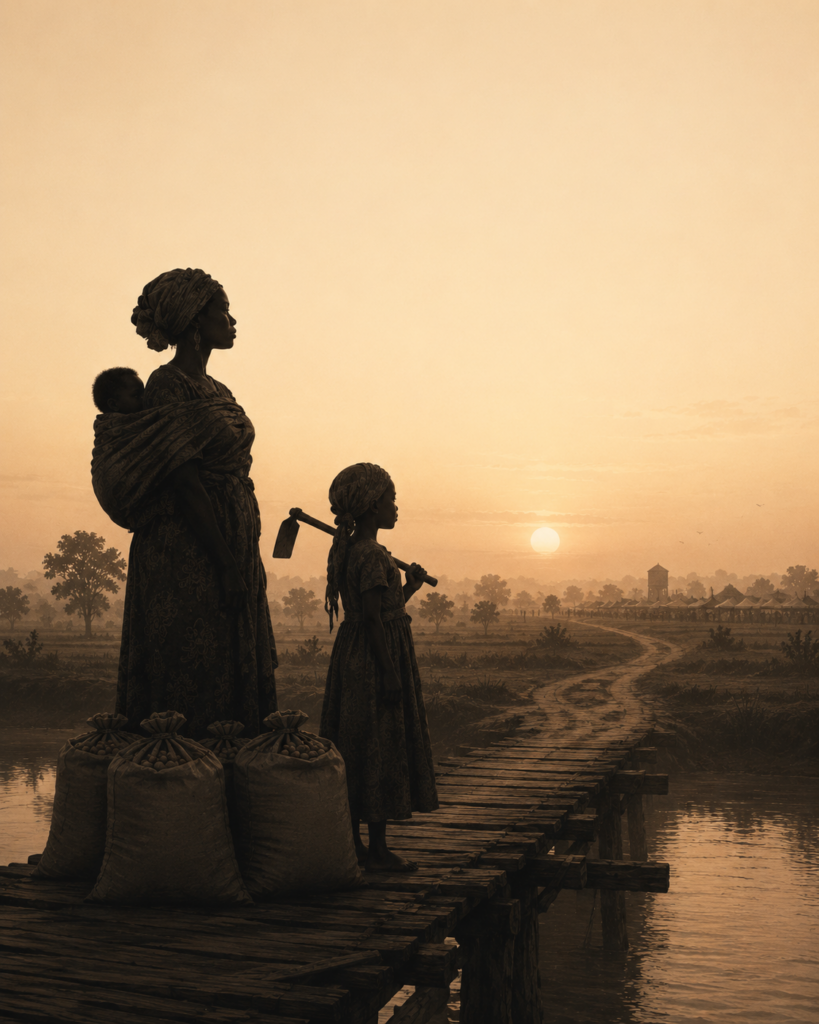
Hadiza does not need to stand on a dusty road waiting for a diesel-scented truck or hoping that a ship will safely cross the Strait of Hormuz.
She needs to stand on her own land.
Backed by her cooperative.
Supported by fair credit.
Strengthened by local inputs.
Connected to markets that do not punish her for being poor, rural, and female.
Feeding her children.
Anchoring the global food supply on terms that recognize her dignity and power.
Hadiza does not need the world to admire her resilience.
She needs a fairer share of its power.
That is the new blueprint for the global frontline.
Author’s Note
Hadiza is a representative persona created to reflect the lived realities of many women smallholder farmers. Maigari and Kano are real; legumes are grown there; and the fertilizer-price pressures described in this series are grounded in research. Her name stands for many women whose burdens rarely make the headlines.
Sources
Food and Agriculture Organization of the United Nations. The State of Food and Agriculture 2010–11: Women in Agriculture — Closing the Gender Gap for Development.
African Union. “We Must Do More to Break Barriers for Rural Women Farmers and Address the Deeply Rooted Structural Inequalities.” 2025.
International Finance Corporation / Global Agriculture and Food Security Program materials on Grainpulse, Uganda, women farmers, fertilizer access, and market linkages.
International Finance Corporation. Scaling Up Farmer Financing Through AgTechs in Sub-Saharan Africa.
International Food Policy Research Institute materials on gender inequality, agrifood systems, climate resilience, and food-system shocks.
World Bank Group materials on agricultural finance, food systems, and gender-inclusive agribusiness.
Journal of Rural Studies. “Beyond the ‘Gender Gap’ in Agriculture: Africa’s Green Revolution and Gendered Rural Transformation in Rwanda.”
Reuters reporting on the Iran-Hormuz crisis, fertilizer, fuel, and food system pressures.
Daily Trust reports on fertilizer prices and the effect of the Iran crisis.